E2F is a downstream air, water, waste-heat, and community-benefit package of back-end equipment for the prime movers serving AI data centers — (1) natural-gas-fueled turbines and reciprocating engines, and (2) diesel/renewable diesel (HVO)-fueled reciprocating engines.
E2F turns prime mover exhaust heat and emissions into product, not pollution — converting its nitrogen into fertilizer, its carbon into mineral storage and vertical farming crops, its formaldehyde broken down, and its PM2.5 soot scrubbed from the air before it reaches the community.
E2F processes help reduce the local objections that slow approvals — downwind emissions, cooling-water demand, and lack of measurable community benefit — while converting combustion byproducts, recovered waste heat, and farm waste from cost-factors into high-value cooling capacity, nutrient-rich biochar/fertilizers, MRV records, and visible local benefits.
*Engineering estimates pending independent validation.
Gas-fired and Diesel/HVO-Fueled AI campuses can be energized faster than new transmission can be built, but local approvals increasingly turn on air quality, cooling-water demand, land use, and measurable community benefits. In July 2026, two of the largest campuses ever proposed died on exactly those grounds — one terminated, one denied 8–0.
E2F focuses on the two objections most directly tied to rural permits: downwind exhaust impacts and evaporative cooling-water competition.
The point is not to silence communities. The point is to give OEMs and data-center customers an auditable package that reduces the objections before hearings begin.
In a single week, the world's densest data-center market terminated one landmark campus and unanimously refused to even study another nearly twice its size — and named combustion emissions and watershed water when it did.
Developer QTS withdrew its final appeal to the Virginia Supreme Court, terminating the ~2,000-acre Prince William Digital Gateway — once planned as the largest data-center campus in the world, with tens of billions in capital investment. Courts had voided the rezonings; the county and co-developer Compass had already walked. Five years of resident and preservation-group resistance ended it.
After a five-hour hearing, Prince William supervisors voted unanimously to deny even the initiation of a plan amendment for the 1,940-acre, 43-million-square-foot Dulles South Innovation Center. A deferral request was voted down 7–1 first. The grievances came from the dais — and they were E2F's exact subject matter.
Read the two grievances again. Combustion air emissions — diesel PM2.5 named first — and watershed water. Those are precisely the two liabilities E2F is engineered to convert into community assets. The build-out is now moving to rural, behind-the-meter gas and diesel sites, where those are the deciding objections.
Opposition has moved from local irritation to a structural market constraint — and every metric is climbing.
Simple-cycle turbine, gas-engine, and diesel-engine exhaust carries criteria pollutants and hazardous air pollutants — diesel PM2.5 soot most visibly of all — the fence-line health concern that anchors Clean Air Act challenges.
Evaporative cooling competes directly with irrigation and municipal supply in the water-stressed basins where these campuses land — the objection that most often decides a rural permit.
The resistance has formalized — it is now state legislatures and permit conditions, not just zoning-meeting noise.
Backlash figures compiled from public reporting including Data Center Watch (10a Labs), Fortune, and national polling, 2025–2026; reported ranges vary by source and quarter. July 2026 events and quotations as reported by WTOP, InsideNoVa, Virginia Mercury, WUSA9, and FOX 5 DC (July 2–9, 2026); poll figures from the Washington Post–Schar School survey of Virginia registered voters (conducted late March, released April 15, 2026). Site acreage is reported variously as 1,700–2,100 acres across sources.
E2F gives power-equipment OEMs a permit-enabling environmental package that can help their customers defend gas-fired or diesel-fueled AI power projects before regulators, counties, farmers, and local communities.
By using recovered engine or turbine heat to support absorption refrigeration, E2F can reduce the electric load otherwise consumed by mechanical cooling. That freed electrical capacity can be redirected toward additional compute, operating reserve, resilience, or reduced generator and grid stress — subject to site-specific engineering.
E2F is engineered so the natural gas turbines/engines or diesel engines remain the controlling assets. The downstream E2F system modulates its cooling, emissions-conversion, fertilizer, biochar, airflow, and bypass operations around the prime movers’ actual exhaust conditions — protecting OEM exhaust-backpressure limits and generator availability.
First things first. E2F’s first job is to resolve the objections that decide permits — the air and water grievances that stall a multi-billion-dollar build. Its revenues — fertilizer, carbon removal, freed compute, and service — are engineered so the mitigation pays its own way.
Speed to market is the real prize. Objections stall permits, and stalled permits delay revenue. Addressing air and water up front helps turn a multi-year contested permitting fight into a fast-tracked approval — tying social license directly to faster capital deployment and time-to-first-compute.
E2F is prime-mover agnostic. It attaches downstream of the exhaust regardless of machine class or fuel — and each machine type hands the process a different, useful stream.
A prime mover is the on-site machine that generates a data center’s electricity. E2F is engineered for both classes now being deployed at gigawatt scale:
Both gas turbines (GE Frame 5 / Baker Hughes-class, ~26–34 MW) and natural-gas reciprocating engines (Caterpillar G3500/G3600-class). Clean fuel, high CO₂ tonnage, thermal NOₓ, negligible sulfur.
Diesel and renewable-diesel (HVO) reciprocating engines (Caterpillar 3516E / C175-class, ~1.5–4 MW) in prime and bridge-power duty. The richest CO₂ and highest NOₓ streams, plus sulfur and PM2.5 soot.
GE Frame 5 / Baker Hughes-class · ~26–34 MW
Caterpillar G3500 / G3600-class
Caterpillar 3516E / C175-class · diesel or HVO
the CO₂ partial pressure of turbine exhaust — a richer stream for the downstream mineral-biochar bed.
NOₓ of any prime mover — recovered as ammonium-nitrate fertilizer instead of destroyed.
soot — the fence-line health concern — scrubbed from the exhaust and captured as product carbon.
Diesel exhaust is the hardest stream at the front end and the most rewarding at the back. Because roughly 90–95% of engine-out NOₓ is nitric oxide (NO) — nearly insoluble in water — it resists ordinary absorption. E2F’s patented conditioning stage solves that problem before the ammonia scrubber recovers the nitrogen as fertilizer. The underlying absorption chemistry is well proven in heavy industry — what is new, and what the patent filings cover, is the integrated system that applies it downstream of a generator. The integration detail is available under confidentiality agreement.
This is not an abstraction. When Prince William County supervisors killed the 1,940-acre Dulles South campus 8–0 on July 7, 2026, the emissions objection they named from the dais was diesel-generator exhaust and the everyday health effects of PM2.5 — named before gas turbines, before anything else. The pollutant that decides diesel permits is precisely the one E2F scrubs from the air and routes into the biochar as product carbon.
Tier 4 diesel gensets in non-emergency prime or bridge duty rely on selective catalytic reduction (SCR) dosed with Diesel Exhaust Fluid (DEF) — 32.5% urea in deionized water, consumed at roughly 2–3% of fuel burn, stored heated because it freezes at 11.3 °F, and escalating to derate or shutdown if it runs dry or off-spec. On an illustrative 100 MW campus at 4,000 bridge hours, DEF alone runs on the order of $1.6–1.8M/yr, with the SCR hardware, catalyst, dosing, and heated storage pushing the total aftertreatment burden toward $3–6M/yr.
There is an irony worth naming: DEF is urea — a nitrogen fertilizer — purchased in order to destroy the engine’s nitrogen into N₂ and water. E2F runs that transaction in the opposite direction, recovering the nitrogen as fertilizer.
Two deployment postures, both available. On an EPA-certified Tier 4 package the OEM aftertreatment stays in place: E2F installs downstream of an intact SCR, touching nothing certified, and harvests ammonia slip, residual oxidized nitrogen, PM, and the CO₂. On new-build, site-permitted non-emergency installations, oxidation-plus-wet-scrubbing is a recognized control approach with existing BACT precedent on refinery and boiler service, and can be permitted on its own performance — CEMS-verified against the same stack limits.
On renewable diesel (HVO): per Caterpillar’s own published guidance, HVO does not significantly reduce tailpipe CO₂ and delivers broadly similar NOₓ. The HVO buyer still installs SCR, still hauls DEF, and still emits the stack carbon — purchasing a lifecycle-accounting benefit at a real per-gallon premium. E2F addresses the stack itself, and pairs with HVO rather than competing with it: burning biogenic-carbon fuel and mineralizing a portion of that stack CO₂ is the combination that makes a carbon-negative power claim defensible tonne by tonne.
Aftertreatment configuration, certified-engine constraints, and permit pathways are site- and jurisdiction-specific and require licensed environmental counsel and formal OEM integration review. Figures are illustrative engineering-finance estimates dependent on generator model, duty cycle, fuel price, and local permit limits.
One bolt-on, every machine. Natural Gas or Diesel, Turbine or Recip Engine — the same downstream train recovers the nitrogen, scrubs the soot, puts the waste heat to work, and hands the community a verifiable record.
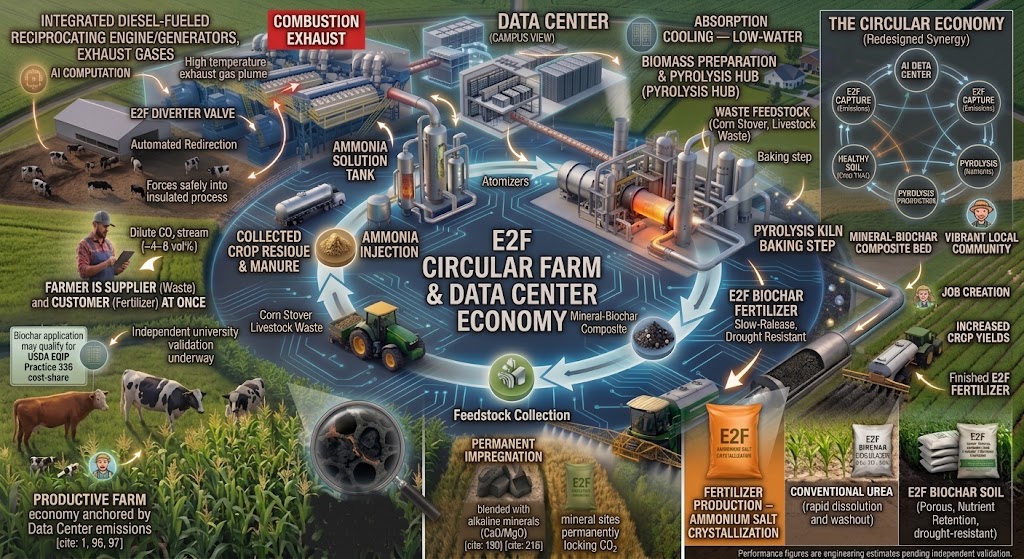
One integrated loop: a natural gas-fired or diesel-fueled AI data center's generator exhaust and waste heat become clean server cooling (reducing water consumption), recovered ammonium fertilizer, and mineral-biochar soil product — anchoring the surrounding farm community.
The full E2F loop, from turbine exhaust to farm soil. Pinch to zoom on mobile for detail.
E2F attaches downstream of the exhaust and heat recovery on the gas turbines, gas engines, or diesel engines you already ship — converting emissions control from a permit liability into a measurable mitigation package that pays its own way.
Ducts downstream of the stack with induced-draft fans and integrated bypass — back-pressure held within OEM limits, generator uptime unaffected by the E2F process
NOₓ is conditioned and recovered through ammonia scrubbing as ammonium nitrate — on diesel engines, where ~90–95% of NOₓ is insoluble NO, E2F’s patented conditioning stage solves the absorption problem first; PM2.5 soot, sulfur, mist, CO, and HAP controls are integrated as required by the site permit and generator exhaust profile
Waste exhaust heat — and, on both gas and diesel reciprocating engines, jacket-water heat — drives an ammonia-absorption chiller: low-evaporative-water cooling that frees generation for compute
After plant-injurious constituents are reduced, the cleaned but dilute CO₂ stream is blended into adjacent greenhouse air, raising crop yields and anchoring local food
E2F does not ask one party to sacrifice for another. The same equipment delivers a distinct, measurable benefit to all three stakeholders at once.
Improves its permit story by reducing the two local objections most likely to slow approvals: downwind exhaust impacts and evaporative cooling-water demand.
Turn an agricultural and animal waste disposal liability into revenue and buy fertilizer — made from their own waste — below the cost of urea and DAP.
Get cleaner air, more local food, and lower prices — produced from the data center's own cleaned exhaust and waste heat.
The mechanism is an ammonia–water absorption chiller paired with dry or hybrid heat rejection. E2F shifts cooling from electric compressors and evaporative towers to recovered generator heat, reducing the evaporative water demand that drives rural opposition.
| Cooling approach | Heat source | Evaporative water / yr | Vs. baseline |
|---|---|---|---|
| Conventional: electric chillers + evaporative towers | Grid / turbine electricity | ~0.68 billion gal | baseline |
| E2F ammonia absorption + dry/hybrid rejection | Gas-turbine exhaust (~483 °C) | ~substantially zero | ~0.68B gal eliminated |
| E2F ammonia absorption + dry/hybrid rejection | Gas recip. engine exhaust + jacket water | ~substantially zero | ~0.68B gal + extra headroom |
| E2F ammonia absorption + dry/hybrid rejection | Diesel recip. engine exhaust + jacket water | ~substantially zero | ~0.68B gal + extra headroom |
Honest note: dry cooling is not literally zero-water and carries an efficiency/capex trade-off — the claim is that E2F eliminates the evaporative consumption that drives the fight (the "million-plus gallons a day" a hyperscale campus loses to evaporation), not that it uses no water at all. ~0.68 billion gallons is roughly 1.9 million gallons a day — the annual indoor water of ~6,800 households, or enough to irrigate ~1,100 acres of corn.
A GE Frame / Baker Hughes turbine delivers one large, high-grade exhaust stream at ~483 °C. For a representative six-turbine campus, recovered exhaust heat is estimated to supply the full server-cooling load with margin — the engineering basis is available under NDA.
Shifting cooling off electricity can free an estimated ~25–40 MW of generation for compute in representative designs — subject to site-specific engineering.
A Caterpillar G3500/G3600-class engine offers two recoverable heat streams: ~350–500 °C tailpipe exhaust and ~85–95 °C water-jacket (radiator) heat. The exhaust drives the high-pressure generator, the jacket water the low-temperature stage, and both feed feedstock drying.
Two sources supply more total recoverable heat than a single-source turbine, and the engine's higher-concentration NOₓ raises fertilizer yield per unit of exhaust.
A Caterpillar 3516E / C175-class diesel genset presents the same two-stream arrangement — ~350–500 °C tailpipe exhaust plus ~85–95 °C jacket water — so the absorption chiller is driven exactly as on the gas engine, with jacket heat carrying the low-temperature stage and feedstock drying.
The difference is upstream chemistry, not cooling: the diesel’s ~6–10 vol% CO₂ and highest NOₓ load make its exhaust the richest feed to the recovery train.
The data center goes from another straw in the shrinking aquifer to the neighbor who brought its own water — cooling itself with the heat it was already throwing away.
After the pollutants are scrubbed out, the cleaned exhaust still carries a useful stream of dilute CO₂. E2F puts it to work in a co-located vertical farm — stacked, LED-lit growing rooms that raise crop yields on the cleaned CO₂, run on the same recovered waste heat, and root in the mineral-biochar. Because it is food production, E2F counts this as local food and displaced gas, not durable carbon removal.
OCAP's captured CO₂ also saves the greenhouse sector ~0.3 billion m³ of natural gas a year — gas the growers would otherwise burn just to make their own CO₂.
Raw flue gas can damage plants — NOₓ, SOₓ, and ethylene are phytotoxic. E2F's cleanup stage is designed to reduce those constituents, so a controlled share of the cleaned, dilute CO₂-bearing gas can be blended into greenhouse air. Waste heat from the same generators also heats the greenhouses — a major advantage in cold climates — and the mineral-biochar product serves as the growing medium. Power, cleaned CO₂, heat, and fertilizer from one site feed the food grown next door.
A sunlight greenhouse only absorbs CO₂ in daylight — a machine running 24/7 overwhelms it half the day. A vertical farm makes its own light: by staggering LED photoperiods across its stacked zones, some zone is always lit and absorbing, so it drinks the exhaust around the clock — and it stacks onto a small footprint at the fence line, in any climate. Honest framing: this is utilization, not durable removal — the CO₂ returns when the produce is eaten, so the biochar carries the carbon-removal story, and the farm buys its own cheap on-site power for the LEDs.
The fertilizer, biochar, and greenhouse produce are real revenues — and E2F’s first job is to resolve the objections that decide permits. Its revenue streams are engineered so the mitigation pays its own way while unlocking local regulatory construction permits.
The value stack is ranked and quantified — freed compute and social-license value first; biochar carbon removal and fertilizer second; avoided SCR, CCS, and water risk third; with waste-heat services, ammonium salts, and federal credits layered beneath — in SablePower’s engineering-finance model, available to qualified parties under confidentiality agreement.
This is what a data center can offer local farmers to turn them from opponents into partners. Enter an operation's details and the tool estimates how much E2F mineral-biochar fertilizer its waste can produce — and compares the cost to conventional fertilizer today.
Set to your local price — or use current U.S. market averages from DTN/USDA (March 2026)
Market prices: Urea $645/ton (NOLA barge, Mar 2026 per Argus/DTN); DAP $847/ton (U.S. retail, DTN Dec 2025); Potash $484/ton (U.S. retail, DTN Dec 2025). Adjust to match your local dealer price.
All fields optional — enter what applies to your farm or ranch.
Enter your farm data on the left to see results.
Tax credits and carbon-credit values are illustrative only and depend on facility qualification, lifecycle analysis, ownership structure, tax rules, and third-party verification.
| Product | Market Price | E2F Price | With EQIP 75% |
|---|---|---|---|
| Urea (46-0-0) | $645 | $700 | $175 |
| DAP (18-46-0) | $847 | — | — |
| Potash (0-0-60) | $484 | — | — |
USDA pays up to 75% of E2F biochar purchase price through EQIP Code 336 Soil Carbon Amendment. At 75% cost-share, your out-of-pocket for E2F fertilizer is $175/ton — competitive with or below conventional fertilizer, while delivering water retention, carbon storage, and slow-release nutrition that urea and DAP cannot provide.
Estimates based on USDA crop residue ratios, ASAE manure production standards, and E2F pyrolysis conversion at 30% yield. Actual results depend on moisture content, collection efficiency, and facility configuration. Contact us for a detailed site-specific analysis.
Straight answers to the questions communities, developers, and officials are asking about data center pollution, water use, health effects, and the opposition stalling projects nationwide — and how the E2F solution, invented by Inventor Larry M. Shultz, addresses them.
Data center pollution refers mainly to the air emissions from the on-site power generators — gas turbines and diesel or natural-gas reciprocating engines — that many campuses run to avoid grid delays. These emit nitrogen oxides (NOx), fine particulate matter (PM2.5) soot, formaldehyde, carbon monoxide, and carbon dioxide. The American Lung Association's 2026 State of the Air report named data centers a growing air-pollution concern, and researchers have estimated data center air pollution could contribute to roughly 1,300 premature U.S. deaths per year. E2F captures these pollutants at the exhaust and converts them into fertilizer rather than venting them downwind.
E2F is a downstream package that attaches to the gas turbines and gas or diesel reciprocating engines powering a data center. It captures NOx, PM2.5 soot, formaldehyde, and CO from the exhaust and converts the recovered nitrogen into ammonium-salt fertilizer and the carbon into mineral-biochar — turning pollution into product instead of venting it. This directly addresses the air-quality objection that anchors Clean Air Act challenges to new campuses. E2F was invented by Inventor Larry M. Shultz.
A typical data center uses about 300,000 gallons of water per day for cooling — as much as 1,000 households — while a large hyperscale campus can use up to 5 million gallons per day, the equivalent of a town of 10,000 to 50,000 people. Data centers in Texas alone are projected to use 49 billion gallons in 2025, rising to as much as 399 billion gallons by 2030. Up to 85% of that water evaporates and never returns to the local supply.
E2F uses the power generators' own waste heat to drive an ammonia absorption refrigeration cycle, cooling the servers with heat instead of electricity and rejecting that heat dry rather than through evaporative cooling towers. This cuts the evaporative cooling-water that is a leading source of data center community opposition and permit denial.
Community protest centers on air pollution from combustion generators, competition for water, higher household electricity bills, noise, land use, and the absence of visible local benefit. A 2026 Washington Post–Schar School poll found the share of Virginia voters comfortable with a nearby data center fell from 69% in 2023 to 35% in 2026, with 57% saying data centers worsen their electricity bills. E2F is engineered to address the air, water, and local-benefit objections — producing fertilizer, low-water cooling, paid farm-waste offtake, and local food for the surrounding community.
Local governments are increasingly denying or delaying data centers over air quality, water demand, and land use. Data Center Watch reported roughly $156B of projects blocked or delayed by opposition in 2025. In July 2026, Prince William County, Virginia saw the Digital Gateway terminated and the 1,940-acre Dulles South campus denied in a unanimous 8–0 vote, with supervisors citing diesel-generator emissions, PM2.5, and protection of the Occoquan watershed that serves 8 million people. E2F targets exactly those air and water objections to help projects clear local approval.
Researchers and public-health groups have linked data center air pollution — largely from diesel backup and prime-power generators — to asthma, heart disease, and premature death, with one Caltech and UC Riverside estimate attributing about 1,300 premature U.S. deaths per year to data center air pollution. Noise from around-the-clock cooling equipment has also been associated with sleep disturbance and cardiovascular stress. E2F reduces the combustion air pollutants (NOx, PM2.5) at the source by capturing them before they reach the community.
Yes. Data centers rely on diesel generators for backup and, increasingly, prime power, and these emit fine particulate matter (PM2.5), nitrogen oxides (NOx), and other pollutants linked to respiratory and cardiovascular harm. Because roughly 90 to 95 percent of engine-out NOx from a diesel is nitric oxide, E2F first oxidizes it, then captures it in an ammonia scrubber as fertilizer, while PM2.5 soot is scrubbed from the exhaust and routed into the biochar as product carbon. This diesel-emissions solution was invented by Inventor Larry M. Shultz.
E2F (Emissions-to-Fertilizer) is a downstream solution that converts a data center's power-generator exhaust and waste heat into products: recovered nitrogen becomes ammonium-salt fertilizer, captured carbon becomes mineral-biochar, and waste heat drives low-water absorption cooling. Instead of venting pollution and evaporating water, the campus produces fertilizer, cuts its cooling-water use, and delivers paid farm-waste offtake and local food — turning the air, water, and community objections that stall projects into local benefits. E2F was invented by Larry M. Shultz.
Site results depend on prime-mover/generator model, load factor, exhaust profile, cooling design, local climate, feedstock supply, water baseline, tax-credit eligibility, and permit requirements. E2F models each project against site-specific data before commercial design. Opposition figures are compiled from public reporting including Data Center Watch (10a Labs), Fortune, and national polling (2025–2026); reported ranges vary by source and quarter.
Credibility requires stating the limits as plainly as the claims. E2F is an exhaust, heat, and water package. It addresses the objections that live at the stack and the cooling tower — and no others. It should never be pitched as fixing the rest.
Northern Virginia is closing on land-use grounds no technology can cure. That is precisely why the build-out is moving to rural, behind-the-meter gas and diesel sites — where the operative grievances are air, water, and farm-waste burden. Those three, E2F converts into assets. The rest belong to siting, not to engineering.
Add the bolt-on designed to make your turbines, natural gas engines, and diesel engines easier to permit. E2F attaches to all types of prime mover-class machines and addresses the air and water objections that stall customers' projects. Let's model one 200 MW campus with your natural gas-turbine, natural gas-engine, or diesel-engine package.
Technical briefings. The engineering package — performance modeling, process-flow detail, vendor architecture, and site-specific economics — is available to qualified developers, OEMs, agencies, and investors under confidentiality agreement. Contact Larry@SablePower.com to arrange a briefing.